Guides · Fires
Slimline vs 3-sided electric fire for a media wall
Slimline front-only electric fires against deep 3-sided fires for media walls, compared on wall depth, height, heat, TV position, build complexity and price, from makers' published figures.
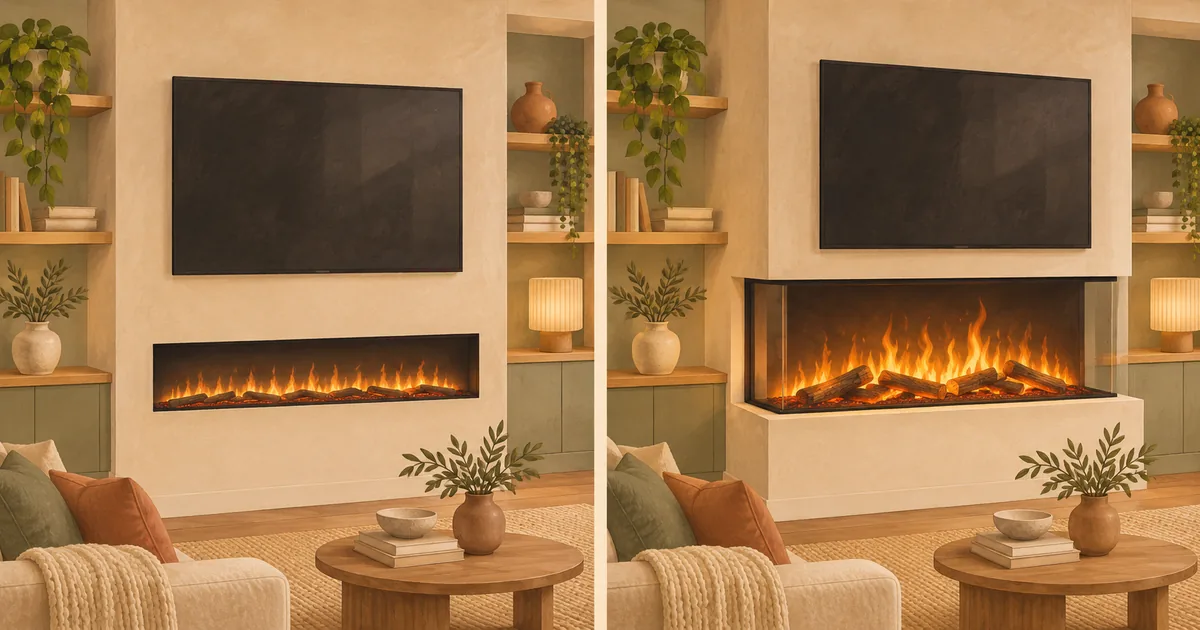
We haven't tested these products. This comparison is based on makers' published specifications and manuals, retailer listings and owner reviews (checked 15 November 2026).
Choose a slimline fire if you want the thinnest wall, the lowest TV and the simplest build. Choose a deep 3-sided fire if the "glass box" look matters more and you can give up about 300–350 mm of floor depth. Most of the other differences follow from those two.
The two styles
- Slimline (front-only or slim 3-sided): typically 150–200 mm deep with a long, low flame. Examples are the Econovex B160 landscape fire (150 mm recess) and the Dimplex Ignite XLF 60 (147 mm deep). Econovex also makes a slimline 3-sided range, such as the E1500SL with a 179 mm recess.
- Deep 3-sided (or "panoramic"): typically 265–311 mm deep, with glass on the front and both ends so the flame shows from the side. Examples are the Econovex E1270B and E1800B (300 mm recess), the British Fires New Forest (300 mm opening) and the Gazco eReflex 135RW (265 mm minimum depth), which can also be built as a one- or two-sided fire.
Side by side
| Slimline | Deep 3-sided | |
|---|---|---|
| Recess depth (examples) | 150 mm (Econovex B160), 179 mm (Econovex E1500SL) | 265 mm (Gazco eReflex), 300 mm (Econovex E-range, British Fires New Forest) |
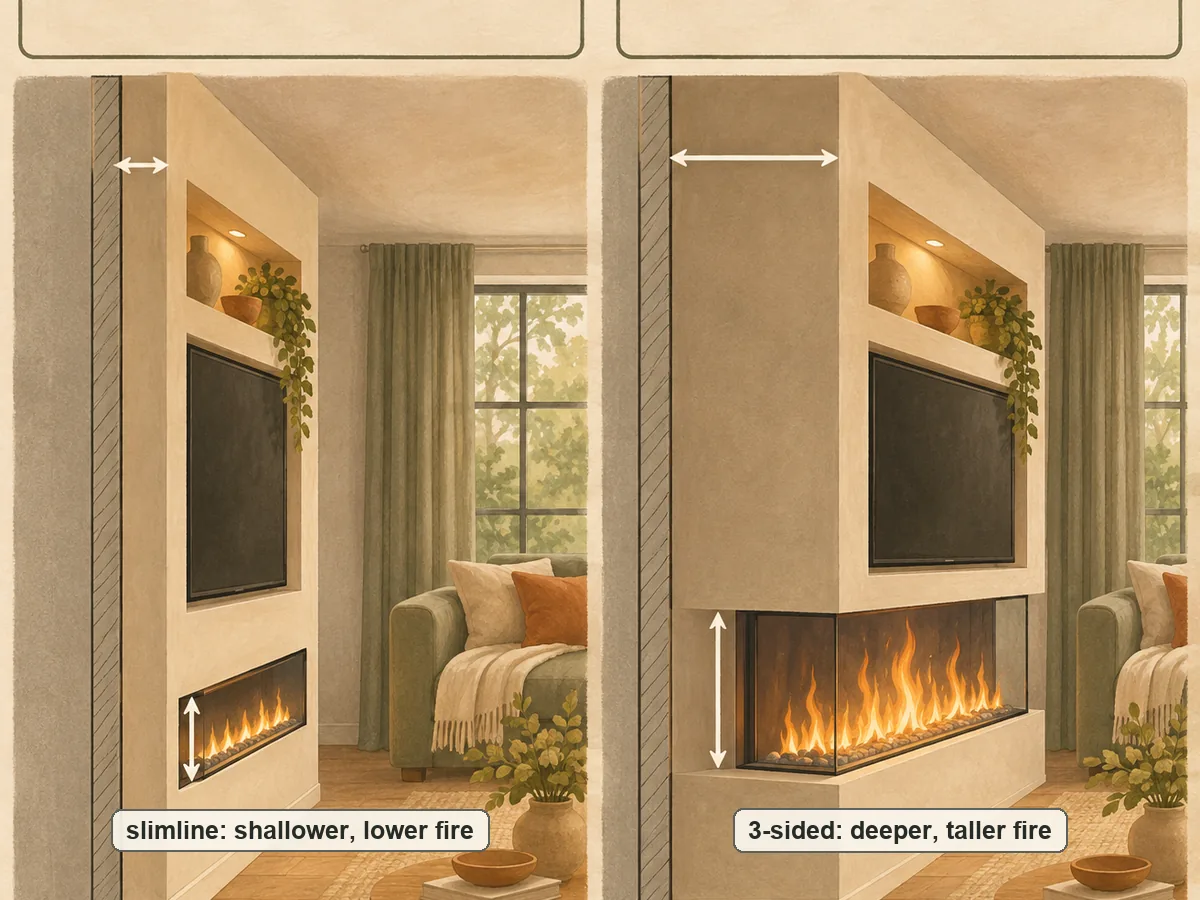
| Typical wall depth | Econovex says about 220 mm built out for its slimline models | Econovex says about 350 mm built out for its deep models |
| Fire height (examples) | 419 mm (Dimplex Ignite XLF 60), 428 mm (Econovex B160), 470 mm (Econovex E1500SL) | 565 mm (New Forest), 570 mm (Econovex E1270B), 575 mm (Gazco eReflex 135RW) |
| Heat output (examples) | 1.5 kW (E1500SL), 1.8–2 kW (Ignite XLF 60) | 1.5 kW (New Forest), up to 2 kW (eReflex), 3 kW (Econovex deep) |
| Look | Long, letterbox flame | Flame visible from the front and the sides |
| Frame | Simpler, shallower box | Deeper box, with return walls built to suit 2- or 3-sided glass |
Sources: Econovex recess sizes and manual, Dimplex Ignite XLF 60, Gazco eReflex manual and British Fires New Forest 1200, all opened on 15 November 2026.
Depth and floor space
This is the biggest practical difference. On a 3.6 m-wide wall, going from about 220 mm to about 350 mm deep costs roughly another 0.47 m² of floor. In a large open-plan room that won't matter; in a small terrace living room it might. You can also build only the centre section deep and step the sides back. See media wall depth and recess.
TV height
Slimline fires are usually 100–150 mm shorter than deep ones, so with the same clearance the TV ends up 100–150 mm lower. If your TV is large or your ceiling low, that can be the difference between comfortable viewing and craning your neck. See TV above an electric fire.
Heat
A deep fire doesn't automatically mean more heat: the New Forest lists 1.5 kW, the same as Econovex's slimline E1500SL. The 3 kW Econovex deep models are the exception, and a 3 kW heater on a 13 A plug is near that plug's limit, which is why Econovex recommends a dedicated circuit. If you plan to run the heater a lot, read the electric fire running cost answer.
Price
On 15 November 2026 the Econovex fire-only page listed its B160 landscape fire at £799, the E1500SL slimline 3-sided at £1,399, and the deep E1270B and E1800B at £1,399 and £1,899. Stoves Are Us showed the Dimplex Ignite XL 60 at about £1,229. Within one brand, deep 3-sided fires generally cost more than front-only fires of a similar width, and the deeper frame adds a little more timber and board.
Which to choose
Slimline suits you if: your room is small, you want the TV as low as possible, you're building on a tight budget, or you want a simpler DIY build.
Deep 3-sided suits you if: the room is wide enough to lose 300 mm+ of depth, the fire will be seen from the side (for example, from a dining area), and you want the more "built-in" look.
Either way, follow your fire's installation manual for the recess and clearances, and size the fire to your TV with our TV-to-fire size table.
Plan it with numbers: the free media wall planner works out the TV height, recess, frame size, depth and a materials list from your room and your fire's published sizes.
Common questions
Can a 3-sided fire be built as front-only?
Some can. The Gazco eReflex 135RW and the British Fires New Forest can be installed as one-, two- or three-sided fires, according to their makers. That lets you buy the deep fire and decide on the glass later in the design. The depth stays the same whichever way you build it.
Is the flame better on a deep fire?
Deep fires have room for a log or pebble bed and show the flame from the sides, which many people prefer. Slimline fires show a long, low flame from the front. We haven't seen these fires side by side, so judge them yourself in a showroom or from the makers' videos.
Does a slimline fire need a dedicated circuit?
Check the manual. Lower-output fires, such as the 1.5 kW Econovex E1500SL, place a smaller load on the circuit than the 3 kW deep models, but the manual and your electrician decide. Read media wall electrics.
Which suits a corner or chimney breast?
A 3-sided fire set into a projecting section, like a chimney breast or a built-out centre, shows its side glass. A front-only fire suits a flat wall. See media wall on a chimney breast.
Sources
Opened and checked on 15 November 2026.
- econovexfires.co.uk/recess-sizes-technical-drawings/
- econovexfires.co.uk/wp-content/uploads/2026/10/econovex-owners-manual-3-sided-deep-and-slimline.pdf
- econovexfires.co.uk/fire-only/
- dimplexfires.com/en-uk/ignite-xlf-60
- stovax.com/download/Technical%20Documents/2.%20Fires/Built%20In%20&%20Wall%20Mounted%20Fires/Electric/eReflex%20Mk2/eReflex%20Range%20Instructions.pdf
- britishfires.com/inset-fires/new-forest-electric-fire-1200/
- stovesareus.co.uk/dimplex-ignite-xl-60-electric-inset-fire.html