Guides · Planning and sizes
What size electric fire for my TV? A TV-to-fire size table
Match your TV's real width to an electric fire width, with a table built from Samsung UK spec sheets, a fire retailer's sizing table and the fire makers' own suggestions.
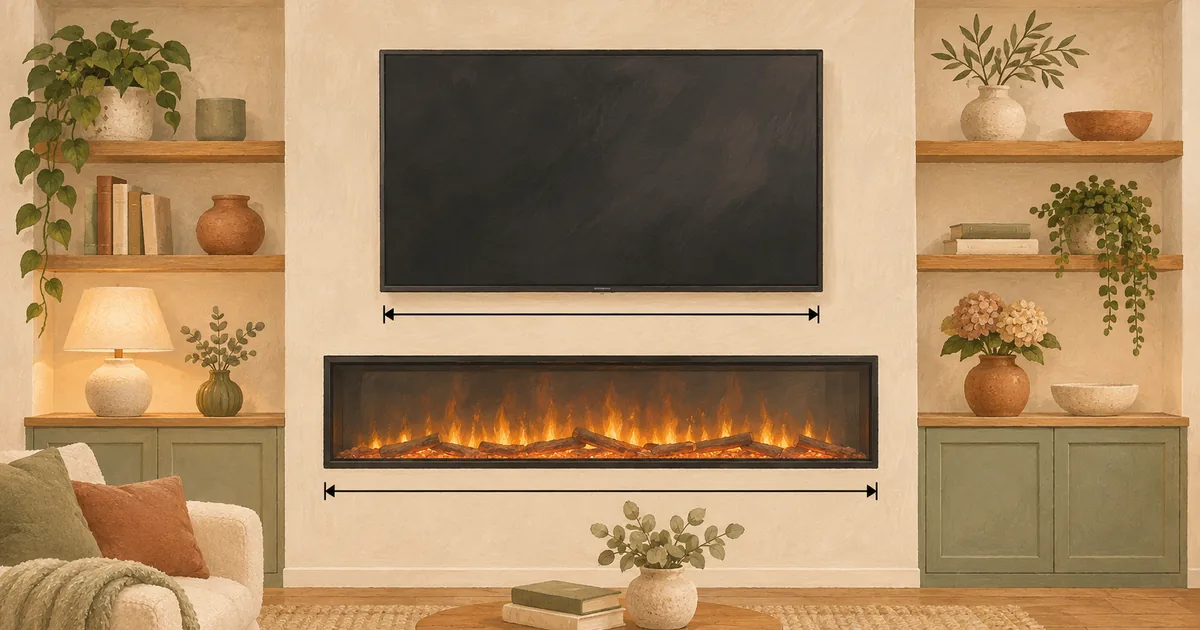
The quick rule most fire retailers use is simple: pick a fire about the same width as your TV, or a little wider. A fire much narrower than the screen tends to look lost under it, while one much wider can make the TV look small. The trick is to compare real widths in millimetres, not the screen size in inches.
Step 1: find your TV's real width
A TV's "65 inch" is the diagonal of the screen, not its width. For a 16:9 screen the width is about 87% of the diagonal, and the frame adds a little more. The most reliable figure is the "size without stand" on your TV's spec sheet.
For example, Samsung UK lists its 2026 Crystal UHD U8000H range without the stand at:
| TV | Width × height without stand |
|---|---|
| 55 inch (UE55U8000HKXXU) | 1224.6 × 707.8 mm |
| 65 inch (UE65U8000HKXXU) | 1444.1 × 831.2 mm |
| 75 inch (UE75U8000HKXXU) | 1668.1 × 957.8 mm |
Other models of the same size differ by a few millimetres, and bezel-heavy or soundbar-integrated TVs by more. Use your own TV's sheet if you have it.
Step 2: match it to a fire width
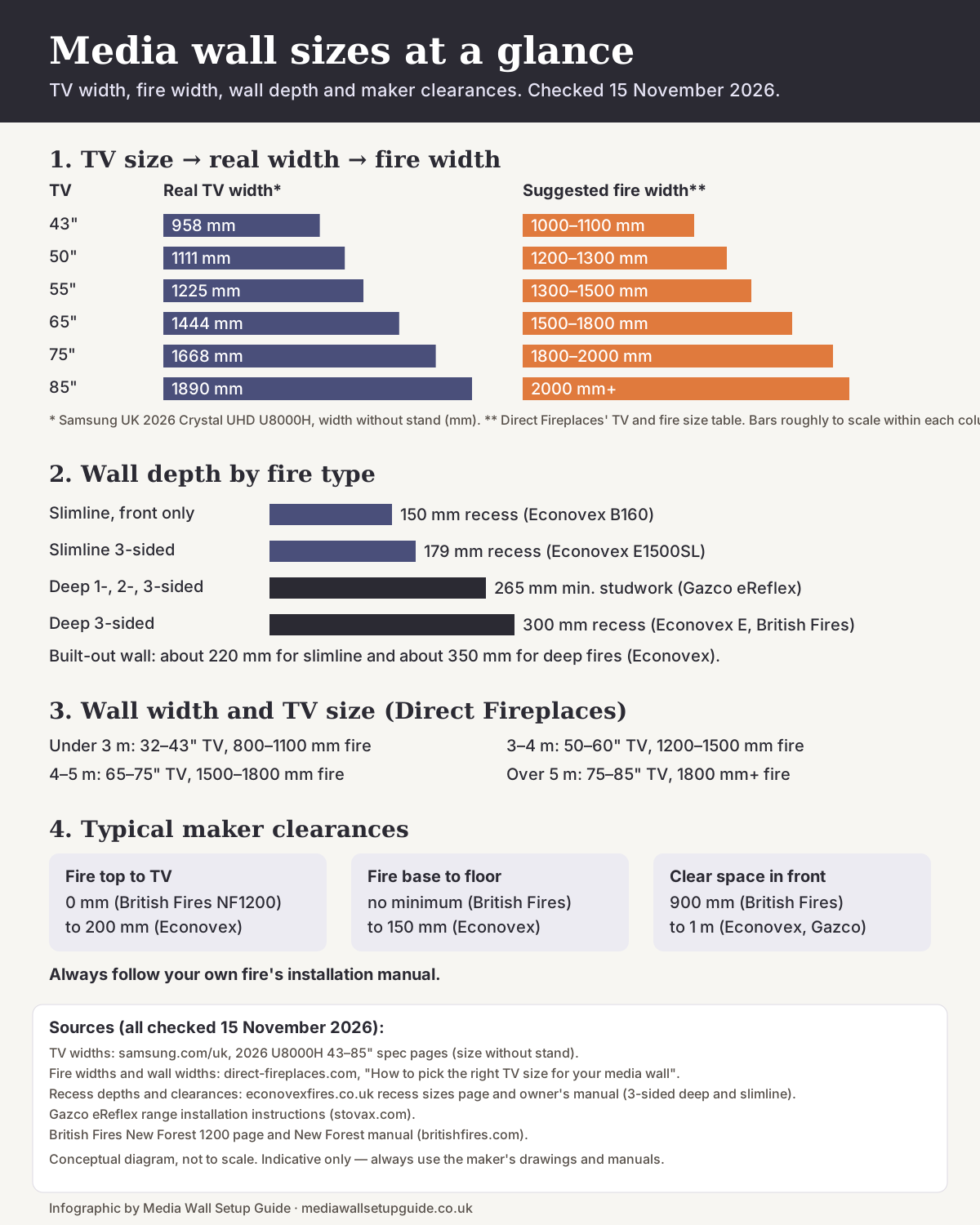
Direct Fireplaces publishes a TV and fire sizing table. Here are its rows for common sizes, next to the Samsung widths above and the 43, 50 and 85 inch models from the same range:
| TV size | Real width (Samsung U8000H) | Fire width suggested by Direct Fireplaces |
|---|---|---|
| 43 inch | 958 mm | 1000–1100 mm |
| 50 inch | 1111 mm | 1200–1300 mm |
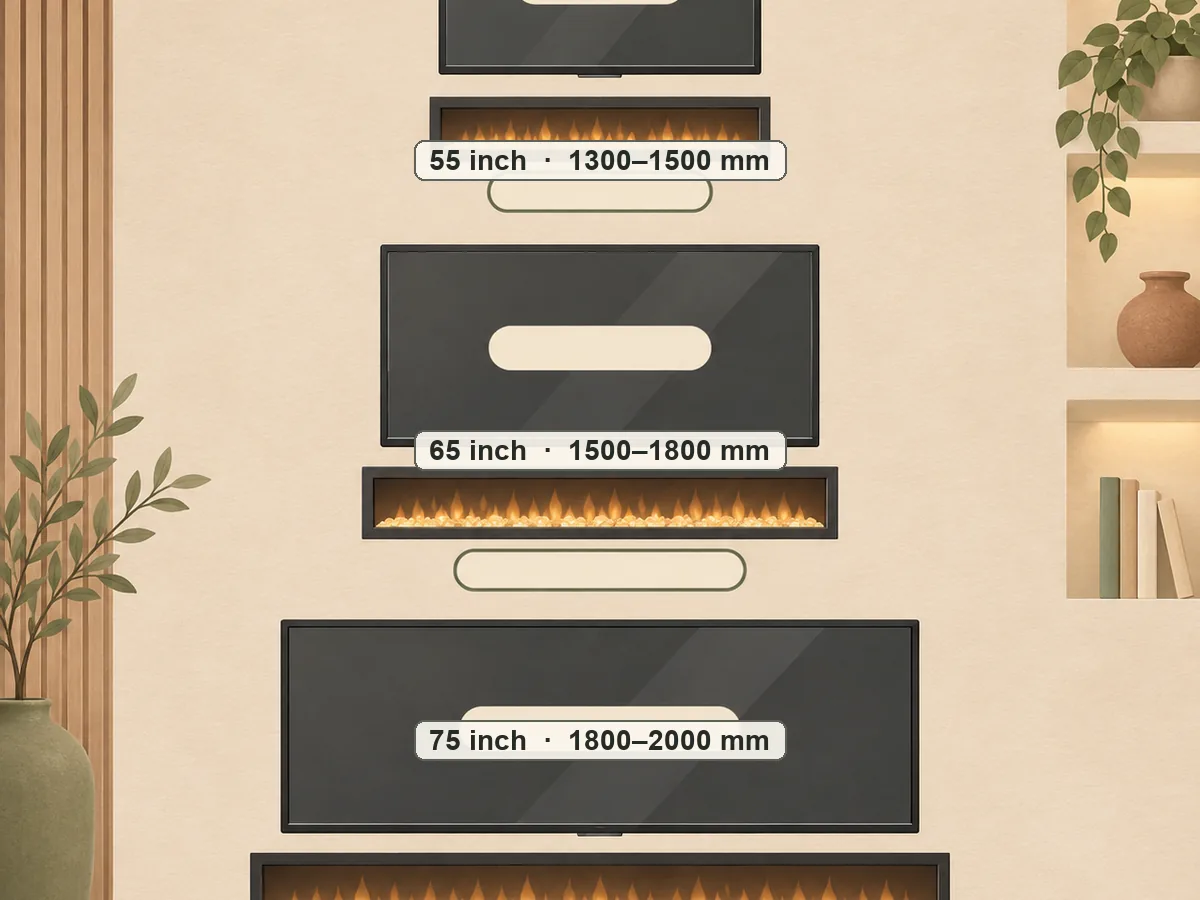
| 55 inch | 1225 mm | 1300–1500 mm |
| 65 inch | 1444 mm | 1500–1800 mm |
| 75 inch | 1668 mm | 1800–2000 mm |
| 85 inch | 1890 mm | 2000 mm+ |
The same page suggests leaving a gap of 100–300 mm between the fire and the TV. That is a styling guide, though, not a safety figure: the minimum gap is whatever your fire's manual says.
What the fire makers suggest
Several makers print a suggested TV size next to each model:
- Econovex pairs the E1270B deep 3-sided fire with 50–55 inch TVs, the E1500SL slimline and B160 landscape fires with 55–65 inch, the E1800B with 65–75 inch and the E2000B with 75–85 inch, on its recess sizes page.
- Gazco suggests the eReflex 135RW for 50–65 inch TVs, the 150RW for 55–65 inch and the 195RW for 65–75 inch.
- British Fires says the New Forest 1200 suits TVs up to 55 inches and the 1600 suits projects with TVs up to 75 inches.
These broadly agree with the retailer table: a 65 inch TV usually pairs with a fire around 1500–1800 mm wide.
Step 3: check the wall can hold both
The fire and TV must also fit the wall. Direct Fireplaces' table puts walls under 3 m with 32–43 inch TVs and 800–1100 mm fires, 3–4 m walls with 50–60 inch TVs, 4–5 m walls with 65–75 inch TVs, and walls over 5 m with 75–85 inch TVs. If you want shelves or alcoves either side, budget for their width too.
Height matters as much as width. A 575 mm-tall deep fire, a 200 mm gap and an 831 mm-tall 65 inch TV add up to more than 1.6 m before you count the height of the fire's base above the floor. The media wall planner does that sum for you and warns you if the screen ends up high.
Viewing distance matters too
LG UK's TV size guide suggests 4K viewing distances of about 1.7 m for a 55 inch, 2.0 m for a 65 inch and 2.3 m for a 75 inch TV, roughly the diagonal in centimetres multiplied by 1.2. If your sofa is much further back, a bigger screen (and wider fire) may suit. If it is closer, a smaller set may be more comfortable.
Common mistakes
- Buying the fire first. You will probably replace the TV before the fire. Size both together, and allow for a slightly bigger screen later.
- Using the visible flame width. The recess width in the manual is what you frame, and it can be wider or narrower than the visible glass.
- Ignoring the depth. A deep 3-sided fire needs a wall about 300 mm deep or more. Read media wall depth and recess.
- Forgetting the TV height. See can you put a TV above an electric fire?
Plan it with numbers: the free media wall planner works out the TV height, recess, frame size, depth and a materials list from your room and your fire's published sizes.
Common questions
Can the fire be wider than the TV?
Yes. Many people prefer a fire a little wider than the screen, and Direct Fireplaces' table suggests fire widths at or above the TV's real width for every size. A much wider fire can make the TV look small, so check the proportions on a scale drawing.
Can the fire be narrower than the TV?
It works, especially with a slimline fire on a TV-only width wall. Gazco, for example, suggests its 1383 mm-wide eReflex 135RW for TVs up to 65 inches, slightly narrower than a typical 65 inch set. A noticeably narrower fire can look lost under a large screen.
What if I don't know which TV I'll buy?
Plan for the biggest TV you're likely to buy in the next few years, and size the recess and bracket pad for that. It's easier to centre a smaller TV in a space planned for a bigger one than the other way round.
Should I centre the fire under the TV?
Usually, yes. If the wall has an off-centre feature, such as a chimney breast or a door, a scale drawing or a cardboard mock-up taped to the wall helps you judge the balance before you build.
Sources
Opened and checked on 15 November 2026.
- direct-fireplaces.com/our-blog/how-to-pick-the-right-tv-size-for-your-media-wall/
- samsung.com/uk/tvs/uhd-4k-tv/u8000h-65-inch-crystal-uhd-4k-smart-tv-ue65u8000hkxxu/
- samsung.com/uk/tvs/uhd-4k-tv/u8000h-55-inch-crystal-uhd-4k-smart-tv-ue55u8000hkxxu/
- samsung.com/uk/tvs/uhd-4k-tv/u8000h-75-inch-crystal-uhd-4k-smart-tv-ue75u8000hkxxu/
- econovexfires.co.uk/recess-sizes-technical-drawings/
- stovax.com/stove-fire/ereflex-electric-fires/ereflex-135rw/
- britishfires.com/inset-fires/new-forest-electric-fire-1200/
- lg.com/uk/lg-experience/helpful-hints/how-to-measure-and-read-tv-sizes/