Guides · Electrics and cables
Media wall electrics and cables: sockets, Part P, HDMI conduit and LED drivers
How to plan power and cables for a media wall in England and Wales, when the work is notifiable under Part P, and how to route HDMI and LED cables so you can change them later.
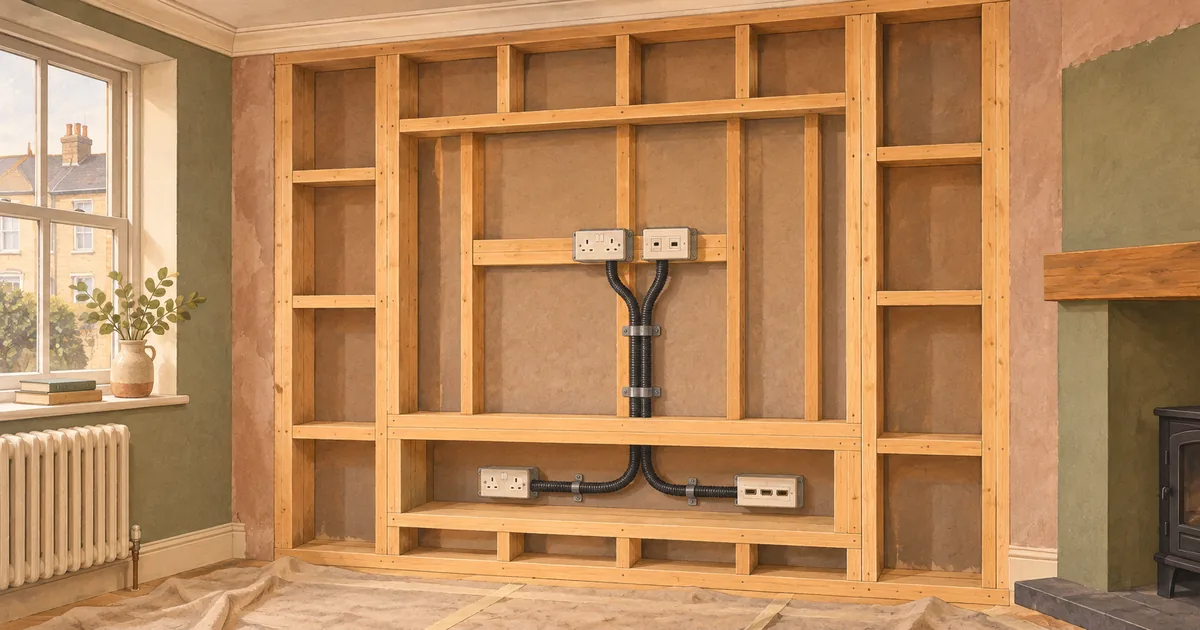
Plan the electrics before the first stud goes up, and use a registered electrician for anything beyond plugging in. A media wall typically needs power for the fire, the TV, any AV kit and the LED drivers, plus a hidden route for HDMI cables. Some of that work is notifiable under the Building Regulations.
Part P in England: what is notifiable
In England, electrical safety in homes is covered by Approved Document P. The 2013 edition lists three kinds of notifiable work:
- the installation of a new circuit;
- the replacement of a consumer unit;
- any addition or alteration to existing circuits in a special location, such as near a bath or shower.
Adding to or altering existing circuits elsewhere is not notifiable, but it must still be done safely and meet the regulations. For a media wall, a new dedicated circuit for the fire would be notifiable. Extra sockets spurred from an existing living-room circuit usually would not be, but they still have to be done properly.
Notifiable work can be self-certified by an electrician registered with a competent person scheme, certified by a registered third-party certifier, or notified to building control before work starts. Electrical Safety First warns that homeowners must be able to prove notifiable work meets Part P. Its DIY advice is blunt: for any electrical work, don't do it yourself, and get a registered competent electrician.
Wales, Scotland and Northern Ireland
- Wales has had its own rules since 2014. Welsh Government guidance says extra power points and alterations to existing circuits are not notifiable except in a kitchen, a bathroom or outdoors, and it treats adding a fused spur in a living room as minor work.
- Scotland uses the Building Standards system. Northern Ireland has no equivalent statutory requirement for domestic electrical work, according to Electrical Safety First.
The safe answer is the same everywhere: get a registered electrician to plan and certify the work.
Powering the fire
Fire manuals differ, so read yours first:
- Econovex deep and slimline 3-sided fires: the manual recommends an appropriate dedicated circuit, with the plug-in point at the top right of the framed opening. Its 3 kW models are close to the 13 A limit.
- British Fires New Forest: the manual says the fire comes with a three-pin plug and 1.8 m of cable. It can be hard-wired into a fused spur as long as the spur is outside the installation, and it must not run from an extension cord.
- Gazco eReflex: the manual calls for a 13 A supply with a BS 1362 13 A fused plug. It says the fire must not be supplied through an external switching device such as a timer.
Electrical Safety First's appliance ratings table puts a fan or radiator heater at up to 13 A (typically 2,000–3,000 W), against under 0.5 A for a 55 inch UHD TV. The fire is the big load on the wall. Never run it from an extension lead: Electrical Safety First warns against overloading and daisy-chaining extension leads.
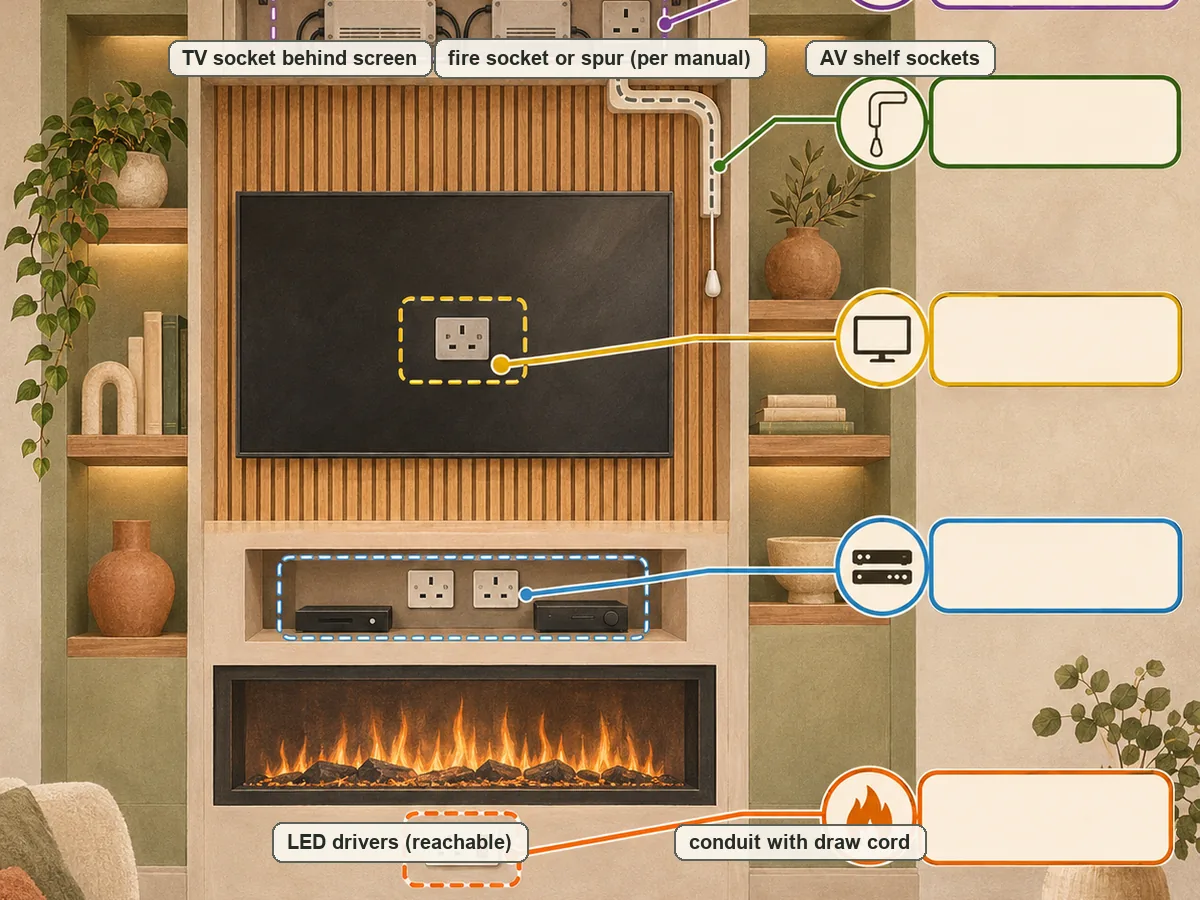
Sockets to plan for
Ask your electrician about:
- Fire: where the manual wants the socket or fused spur, and whether it must stay reachable once the wall is boarded.
- TV: a socket behind the screen, so the TV's plug and lead don't hang down.
- AV shelf or cabinet: sockets for a soundbar, games console, set-top box and router.
- LED lighting: a home for each LED driver (power supply) where it stays ventilated and you can reach it, plus a switched supply if you want the lights on a wall switch.
Hiding HDMI and other cables
The aim is to leave a route you can reuse, not to bury cables for good:
- Run flexible conduit from behind the TV position to the AV shelf before boarding. Wickes sells 20 mm × 5 m black corrugated flexible conduit (£7 on 15 November 2026). Use a larger size or two runs if you need several HDMI cables.
- Leave a draw cord in every conduit so you can pull a new cable through later.
- Fit brush plates or cable grommets at each end. A kit like the HomeMount TV wire concealer is listed for 12–18 mm plasterboard or wooden walls and up to four HDMI cables.
- Buy HDMI cables of the right standard and length. For a 4K 120 Hz console or eARC soundbar you need HDMI 2.1, for example the UGREEN HDMI 2.1 cable, 2 m, listed at 48 Gbps.
- For pulling cables through an existing cavity, a cable access rod kit helps.
Keep mains cables and data cables in separate routes where you can, and never put mains cable in a conduit meant for low-voltage cables without your electrician's say-so.
Before you fix anything
Find cables and pipes in the existing wall before you drill. Electrical Safety First warns about drilling, nailing or screwing near hidden cables. A detector such as the Franklin Sensors ProSensor M210, listed as detecting live wires as well as studs, is a useful check, but it does not guarantee a safe zone. If in doubt, ask your electrician.
Indicative only. Always follow your fire's installation manual and your TV maker's instructions, and use a qualified electrician for new wiring.
Common questions
Should the fire's socket be inside the recess?
Only if the manual says so. Econovex's manual places the plug-in point at the top right of the framed opening. British Fires allows a fused spur, provided the spur is outside the installation. Either way, you need to be able to isolate the fire without taking the wall apart.
Can I put the TV socket behind the screen?
Yes, and it's the neatest option. Ask your electrician to put it where the TV's power lead reaches without strain, and where a fixed bracket leaves enough room for the plug. Recessed or slimline sockets help.
How many HDMI cables should I allow for?
Count every device that will connect to the TV (set-top box, games console, streaming box, soundbar), then add one spare. A conduit with a draw cord means you can add more later.
Who signs off the work?
For notifiable work in England, a registered electrician self-certifies it and you should receive a certificate. If you use an unregistered installer, Approved Document P says building control must be notified before work starts. Keep the paperwork: Electrical Safety First notes you must be able to prove notifiable work meets Part P.
Sources
Opened and checked on 15 November 2026.
- gov.uk/government/publications/electrical-safety-approved-document-p
- assets.publishing.service.gov.uk/media/5a802da7ed915d74e622ceed/BR_PDF_AD_P_2013.pdf
- electricalsafetyfirst.org.uk/find-a-registered-electrician/part-p-of-the-building-regulations/
- electricalsafetyfirst.org.uk/find-a-registered-electrician/building-regulations/
- electricalsafetyfirst.org.uk/safety-advice/home-and-people/diy-ers/
- gov.wales/building-regulations-electrics
- electricalsafetyfirst.org.uk/safety-advice/home-and-people/house-maintenance/extension-leads-cable-reels-and-block-adaptors/
- electricalsafetyfirst.org.uk/safety-advice/home-and-people/house-maintenance/ratings-of-electrical-appliances/
- econovexfires.co.uk/wp-content/uploads/2026/10/econovex-owners-manual-3-sided-deep-and-slimline.pdf
- cdn.earthstorm.media/britishfires.com/88/8806f0e75cf18bb9cd0cbc96adeef4fe.pdf
- stovax.com/download/Technical%20Documents/2.%20Fires/Built%20In%20&%20Wall%20Mounted%20Fires/Electric/eReflex%20Mk2/eReflex%20Range%20Instructions.pdf