Guides · Finishing and lighting
Media wall lighting and LED strips: planning, drivers and wiring
How to plan LED strip lighting on a media wall, covering where to put the strips, plug-in kits or wired drivers, COB vs standard strips, colour temperature and keeping drivers reachable.
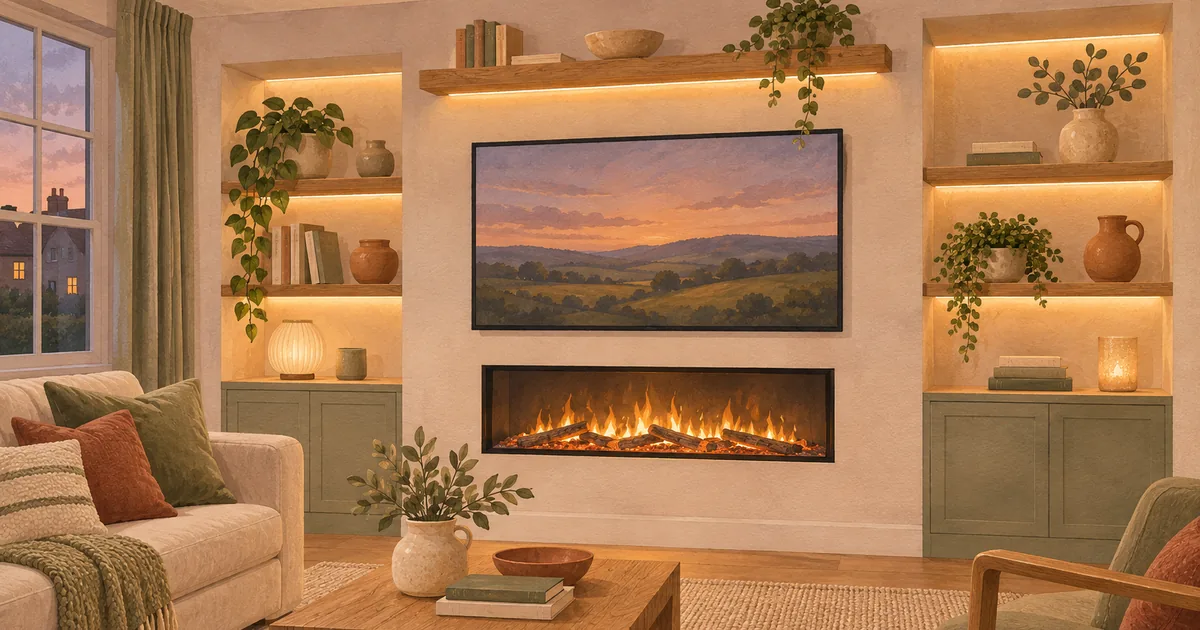
We haven't tested these products. This comparison is based on makers' published specifications and manuals, retailer listings and owner reviews (checked 15 November 2026).
Decide where the light goes and where the power supplies (drivers) will live before you board the wall. LED strips are cheap and easy to change. What's hard to change later is a missing cable route or a driver sealed behind plasterboard.
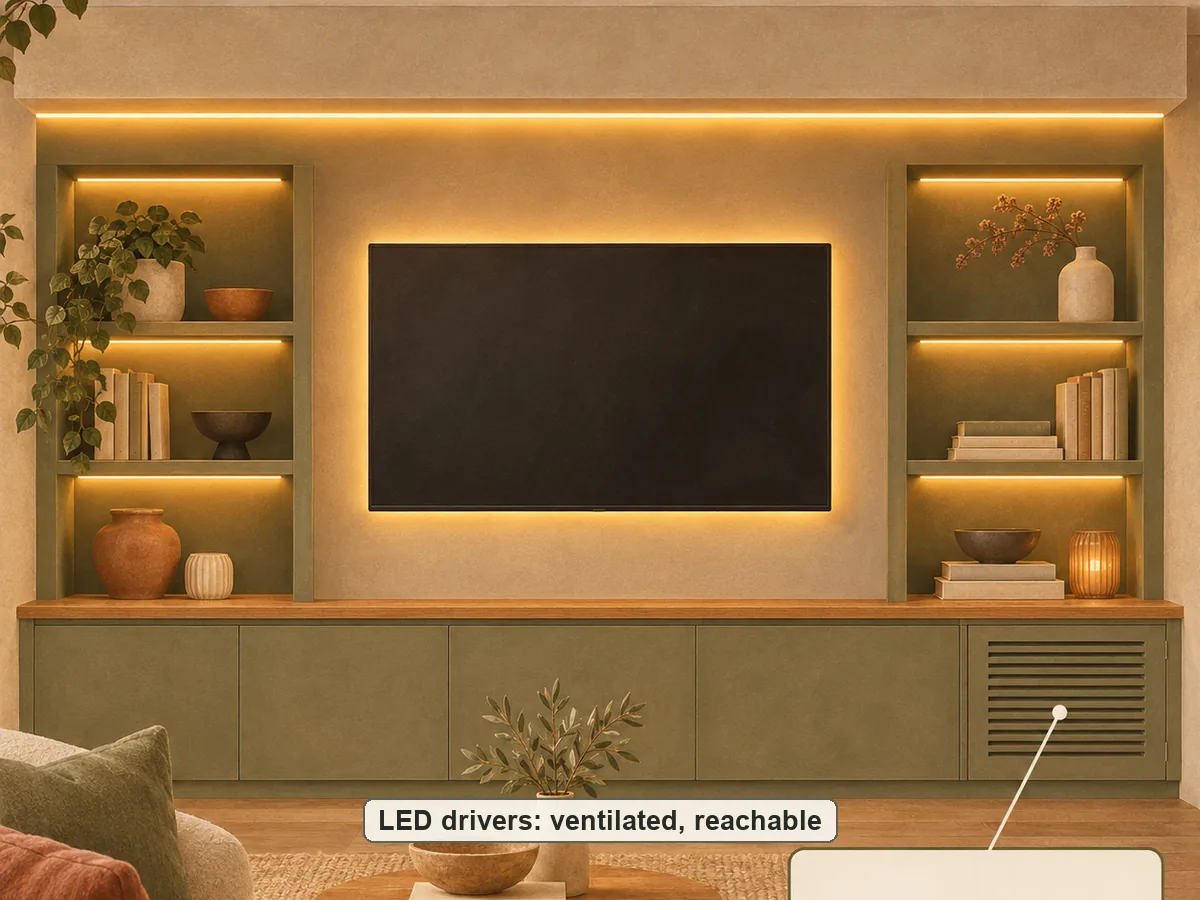
Where LED strips work on a media wall
- Recessed shelves and alcoves: a strip along the top or back edge of each shelf recess gives an even wash.
- Behind or around the TV: a strip behind the screen gives a soft halo that some people find easier on the eyes in a dark room.
- Under floating shelves or a bulkhead: downlight effect without fitting spotlights.
- Skirting or plinth: a low glow along the base of the wall.
Keep strips and their wiring away from the fire's heat outlet, and outside any zone the fire's manual says to keep clear. Econovex's manual, for example, sets clearances above its fires to a mantel, a TV and the ceiling, so treat a strip directly above the fire with care.
Plug-in kits or wired lighting
There are two routes:
- Plug-in low-voltage kits. The strip runs at 12 V or 24 V from a power supply that plugs into a socket. You can fit these yourself, as long as you don't alter any mains wiring. Plan a socket for each driver (or one switched socket for all of them).
- Wired into a lighting circuit, so the strips come on from a wall switch. This means new mains wiring, so use a registered electrician. In England, Approved Document P makes new circuits notifiable, while additions to existing circuits outside special locations are not notifiable but must still be safe and compliant. In Wales, Welsh Government guidance says extra lighting points are not notifiable except in kitchens, bathrooms and outdoors. Electrical Safety First's advice for DIY-ers is to use a registered competent electrician for any electrical work.
Whichever route, don't power the lighting, the TV and the fire from one extension lead. Electrical Safety First warns against overloading extension leads and daisy-chaining them.
COB or standard LED strips
- Standard SMD strips have visible individual LEDs. Without a diffuser channel they can show as dots on a gloss surface.
- COB (chip-on-board) strips pack the LEDs so closely that the line looks continuous, even without a diffuser. They are popular for shelf recesses.
As an example of the COB type, the TTWAY COB LED strip kit, 2700K, 5 m is listed on Amazon UK as a 24 V, 8 mm-wide strip with 2,400 LEDs, CRI 90+, 36 W, an RF remote, and a UKCA-marked power supply included. Check the listing's current details and whether the cut points suit your shelf lengths before you buy.
Colour temperature
Colour temperature is measured in kelvin (K). Lower numbers look warmer:
- around 2700K is a warm white similar to traditional bulbs, and suits a living room in the evening;
- around 4000K is a neutral white;
- RGB or RGBW strips change colour, and usually need their own controller.
Match the strips to the other lights in the room. Mixing a cool white strip with warm lamps tends to look odd.
Drivers: keep them cool and reachable
The driver (or power supply) is the part most likely to fail first, so:
- put it somewhere accessible: an AV cupboard, a removable panel or a shelf, not sealed behind plasterboard;
- give it air: don't wrap it in insulation or box it tightly;
- size it with headroom over the total wattage of the strips it powers, as the strip maker advises;
- keep the low-voltage runs to it short, or follow the maker's guidance on voltage drop over long runs.
Fitting tips
- Plan cable routes in the frame. Drill the studs or leave a gap for the low-voltage cable from each strip to its driver, ideally in conduit with a draw cord. Our electrics and cables guide shows how.
- Use aluminium channels in recesses. They help the strip shed heat and give a neat line with a diffuser.
- Finish the walls first. Adhesive tape sticks badly to fresh paint and dusty plaster. Wait until the paint has cured.
- Test before you fix. Lay out and light each strip before peeling off the backing.
Finishing touches like paint and slat panels are covered in media wall finishes and panelling.
Common questions
Can LED strips go inside the fire recess?
Not unless the fire's manual allows it. The recess is the fire's space: it may get warm, and the fire's own lighting and air flow are designed around it. Put strips in the shelf recesses and around the TV instead.
How do I control everything from one switch?
Plug-in kits usually come with a remote, as the TTWAY kit above does. To put several drivers on one wall switch, ask an electrician for a switched supply to an accessible cupboard where all the drivers plug in. Smart plugs are another option for plug-in kits, as long as each one is rated for its load.
How bright should the strips be?
Media wall lighting is usually accent lighting, not the room's main light, so a dimmable strip gives you more control than a very bright one. Check the listing for a dimmer or a compatible controller.
Do LED strips get hot?
They give off some heat, which is one reason strips are often fitted in aluminium channels. The bigger heat source is usually the driver, so keep it ventilated and out of insulation, as above.
Sources
Opened and checked on 15 November 2026.
- assets.publishing.service.gov.uk/media/5a802da7ed915d74e622ceed/BR_PDF_AD_P_2013.pdf
- gov.wales/building-regulations-electrics
- electricalsafetyfirst.org.uk/safety-advice/home-and-people/diy-ers/
- electricalsafetyfirst.org.uk/safety-advice/home-and-people/house-maintenance/extension-leads-cable-reels-and-block-adaptors/
- econovexfires.co.uk/wp-content/uploads/2026/10/econovex-owners-manual-3-sided-deep-and-slimline.pdf