Guides · Fires
Electric fire vs wood burner on a media wall
Why an inset electric fire suits a timber-framed media wall better than a wood-burning stove, comparing installation, flues, clearances to a TV, running costs and smoke control rules.
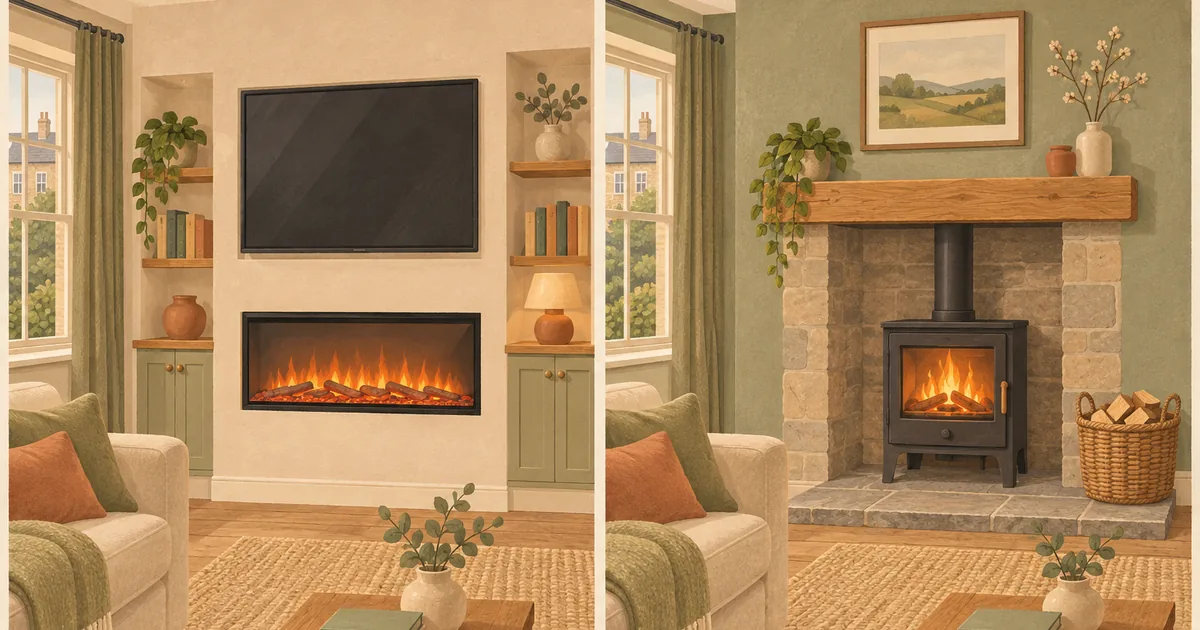
For a timber-framed media wall with a TV above, an inset electric fire is the practical choice. A wood-burning stove needs a flue or chimney, a hearth and non-combustible surroundings, and it produces far more heat near the TV. You can have both in one room, but they are different projects.
Why media walls use electric fires
A media wall is a stud frame faced with plasterboard, with a recess for the fire and a TV above. Electric media wall fires are designed for exactly that:
- No flue. They need a power supply, not a chimney. That's why media walls work in new-builds without a chimney.
- Built into studwork. Makers publish a recess size for a timber or metal stud enclosure. Econovex's manual, for example, gives zero clearance to the sides and back of the fire.
- A known gap to a TV. Some manuals state the minimum gap to a TV above (Econovex says 200 mm).
- Flame without heat. Many electric fires run the flame effect alone. A Dimplex product sheet lists 25 W for flame effect only, against 2,000 W with the heater on.
Why a wood burner is a different project
Solid-fuel stoves are covered by Approved Document J of the Building Regulations in England, which deals with hearths, fireplaces, flues and chimneys and with protecting the building from the heat. In practice that means:
- a lined chimney or a flue system;
- a non-combustible hearth and surround, with stated distances to combustible materials;
- installation that meets the Building Regulations by a qualified solid-fuel installer;
- burning only authorised fuels or using an exempt appliance if you live in a smoke control area. GOV.UK says that in England you may have to pay a penalty of up to £300 if your chimney releases smoke in one.
None of that fits naturally inside a timber stud wall with a TV above. TV makers are also wary of heat: Samsung's wall-mounting advice says its TVs should never exceed 40 °C, and suggests checking the temperature with the fire lit before mounting over a fireplace.
If you're seriously weighing a real stove, Logcroft's guide to inset vs freestanding stoves covers the installation side, and the answer there is to use a qualified solid-fuel installer.
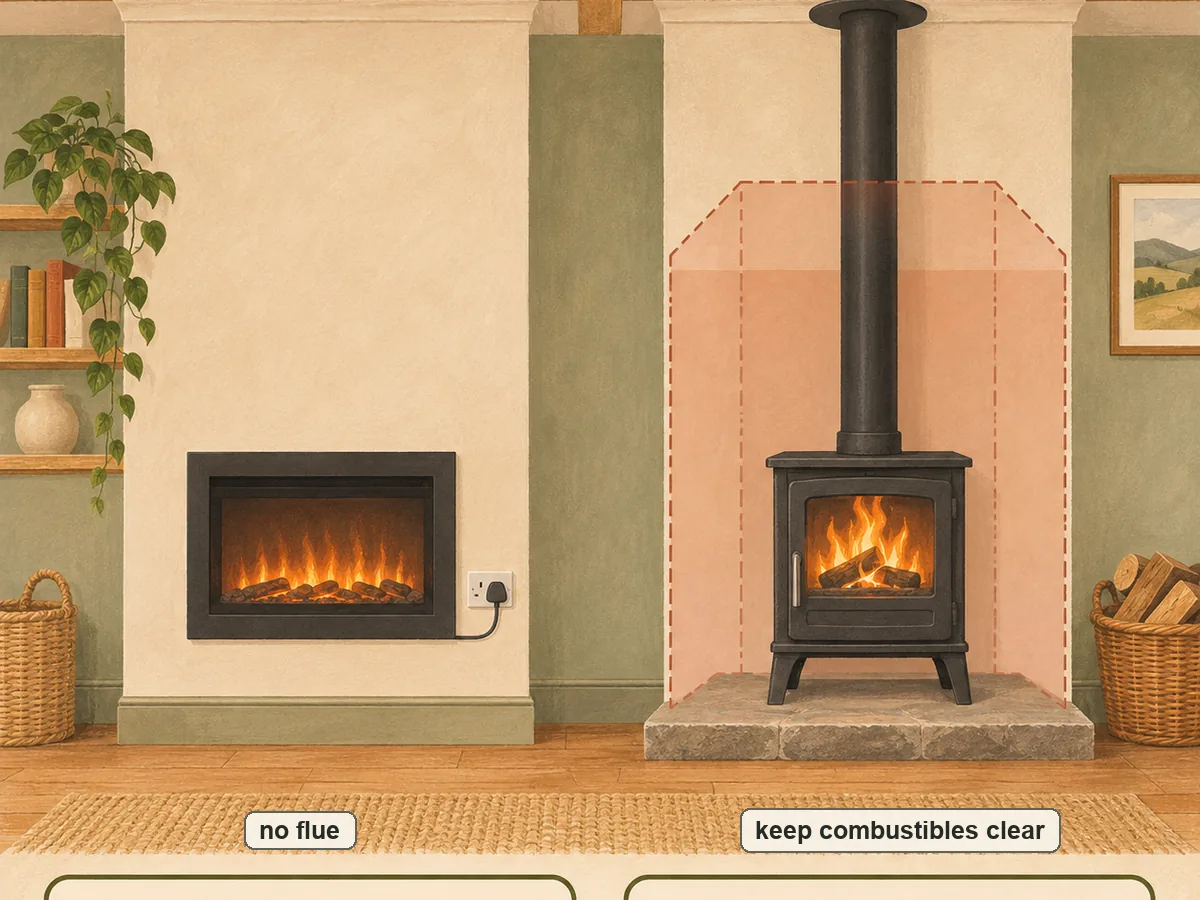
Side-by-side
| Inset electric fire | Wood-burning stove | |
|---|---|---|
| Chimney or flue | Not needed | Needed |
| Fits inside a stud frame | Yes, to the maker's recess size | Not without non-combustible construction, by design and installer sign-off |
| TV above | Possible within the manual's clearance | Generally not recommended by TV makers because of heat |
| Fuel | Mains electricity | Logs or approved fuel; smoke control rules may apply |
| Heat | 1.5–3 kW for the media wall fires in our round-up | Depends on the stove; radiant heat close to the appliance |
| Install | Plug-in or a fused spur; electrician for new circuits | Qualified solid-fuel installer, to Approved Document J |
Running cost and heat
Electric heaters turn almost all the electricity they use into heat at the point of use. EDF describes electric radiators as 100% efficient at the point of use. That doesn't make them cheap: the Energy Saving Trust notes that electricity is around four times more expensive than gas per unit, and that heat pumps are about three times more efficient than standard electric heaters. So an electric media wall fire is best seen as top-up heat and a focal point, not a replacement for central heating. Our answer on what an electric fire costs to run does the sum with the current price cap rate.
Already have a chimney?
If the room has a chimney breast, you can build a media wall over or around it, but don't block the flue's ventilation. The Society for the Protection of Ancient Buildings' technical note says disused flues must be ventilated top and bottom to avoid condensation. Read building a media wall on a chimney breast.
The verdict
For a TV-and-fire media wall, choose an inset electric fire and follow its manual. If you want the real flame and radiant heat of a stove, plan it as a separate, properly installed stove with its own hearth and flue, and keep the TV well away from it.
Common questions
Can I put a TV above a wood burner?
TV makers advise against heat sources under a TV. Samsung UK's product guide says not to place the set near or over a radiator or heat register. Samsung's wall-mounting advice says the TV should never exceed 40 °C, and suggests lighting the fire and checking the temperature first. A stove's surround also has to meet the clearances in the stove maker's instructions and Approved Document J. So plan the TV for another wall, or well to one side of the stove.
Do electric fires need ventilation?
They don't need a flue, but some manuals ask for air gaps or vents in the enclosure. Gazco's eReflex manual, for example, asks for a 5,000 mm² free-air vent in the enclosure for inset models under 1 m long. Follow your manual.
Will an electric fire add value like a stove?
We haven't verified a reliable UK source that measures the effect of a media wall or an electric fire on house prices, so we won't put a figure on it. Choose it for how you'll use the room.
Can I have a stove and a media wall in the same room?
Yes, as separate features. Put the media wall, with or without an electric fire, on one wall, and the stove on its own hearth with its flue on another. Keep the TV and any timber or MDF joinery outside the stove's stated clearances. If the stove will be the room's main heat, you may not need a heater in the media wall at all: a flame-effect fire or no fire keeps the wall simpler.
Sources
Opened and checked on 15 November 2026.
- gov.uk/government/publications/combustion-appliances-and-fuel-storage-systems-approved-document-j
- gov.uk/smoke-control-area-rules
- edfenergy.com/heating/electric/radiators
- energysavingtrust.org.uk/advice/electric-heating/
- dimplex.co.uk/sites/g/files/emiian426/files/2024-04/Product%20Sheet%20-%20Sunningdale_0.pdf
- econovexfires.co.uk/wp-content/uploads/2026/10/econovex-owners-manual-3-sided-deep-and-slimline.pdf
- samsung.com/au/support/tv-audio-video/things-to-consider-before-mounting-the-tv-on-a-wall/
- logcroft.co.uk/choosing/inset-vs-freestanding-stoves/
- spab.org.uk/sites/default/files/SPAB%20Technical%20Advice%20Note_Fireplaces%2C%20Flues%20and%20Chimneys.pdf
- samsung.com/uk/support/basic-product-guide-tv/
- stovax.com/download/Technical%20Documents/2.%20Fires/Built%20In%20sources: [https://www.gov.uk/government/publications/combustion-appliances-and-fuel-storage-systems-approved-document-j
- gov.uk/smoke-control-area-rules
- edfenergy.com/heating/electric/radiators
- energysavingtrust.org.uk/advice/electric-heating/
- dimplex.co.uk/sites/g/files/emiian426/files/2024-04/Product%20Sheet%20-%20Sunningdale_0.pdf
- econovexfires.co.uk/wp-content/uploads/2026/10/econovex-owners-manual-3-sided-deep-and-slimline.pdf
- samsung.com/au/support/tv-audio-video/things-to-consider-before-mounting-the-tv-on-a-wall/
- logcroft.co.uk/choosing/inset-vs-freestanding-stoves/
- spab.org.uk/sites/default/files/SPAB%20Technical%20Advice%20Note_Fireplaces%2C%20Flues%20and%20Chimneys.pdf]%20Wall%20Mounted%20Fires/Electric/eReflex%20Mk2/eReflex%20Range%20Instructions.pdf